Once the grapes arrive at the winery, we must begin making our wine as soon as possible, otherwise the fruity aromas and fresh fruit flavors will be lost. Therefore, we will now delve into the different techniques used for both artisanal and industrial winemaking in the Rías Baixas Designation of Origin (D.O.).
CRUSHING
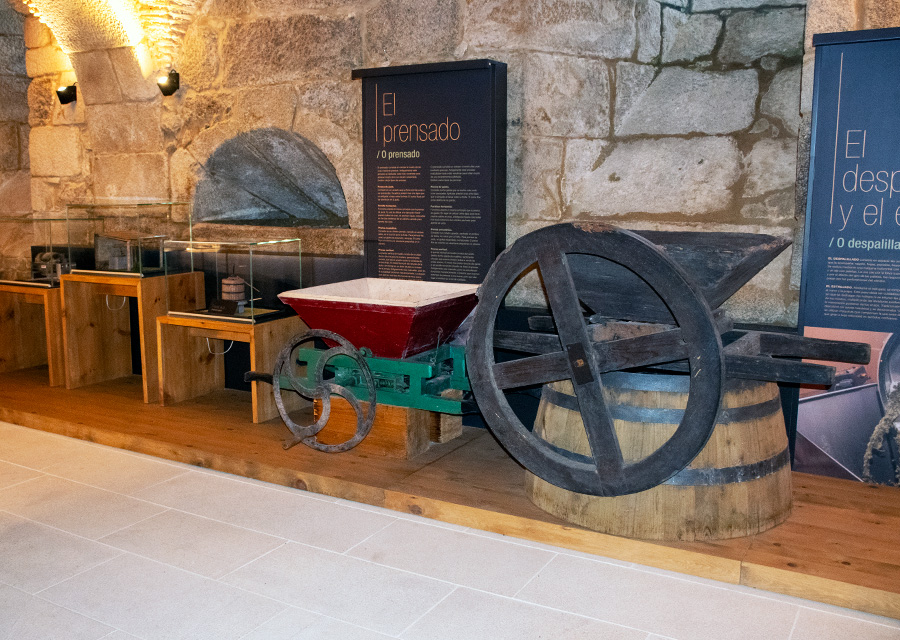
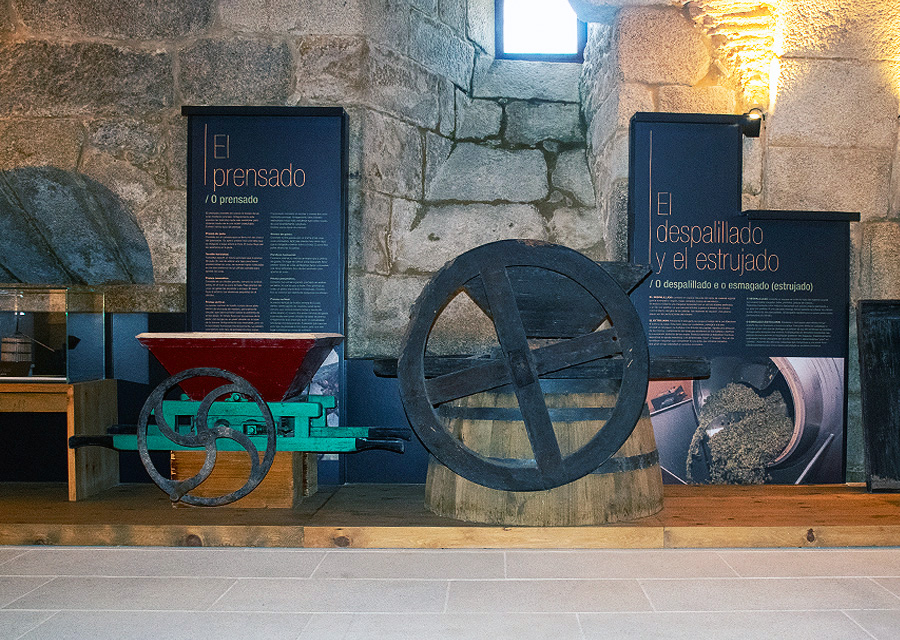
First, we must carry out the crushing process, which replaces the old method of treading and serves to break the grape skins without crushing the seeds, as these can contribute tannins and astringency to the must. Following the "lareira" (hearth), we find two crushers: one an original, antique piece made entirely of wood, and another that combines wood and iron, a design evolution that allows us to regulate the pressure applied.
With this process, crushing, we encourage the natural sugars in the pulp to come into contact with the yeasts present on the skin.
All the grape pulp falls from the crusher into a wooden vat placed underneath. The wine then begins to ferment, transforming the sugar consumed by the yeasts into alcohol and carbon dioxide.
It is at this point that the wine's problems begin, as the grape pulp, upon contact with oxygen, starts to oxidize. To understand this more easily, think of an apple with its skin removed; deprived of its natural coating, it begins to change color and lose some of its flavor. Well, the same thing happens to crushed grapes. For all these reasons, in the 19th century, the great French chemist Louis Pasteur, in his study of yeasts, discovered how potassium metabisulfite is effective against oxidation and in wine preservation. That is why even today, we can find information regarding the use of sulfites on wine labels.
PRESSING
Once the wine has fermented, we remove the liquid, leaving us with a remaining pulp composed mainly of skins and stems. We will subject these fermentation remnants to another process to obtain the maximum possible yield: pressing.
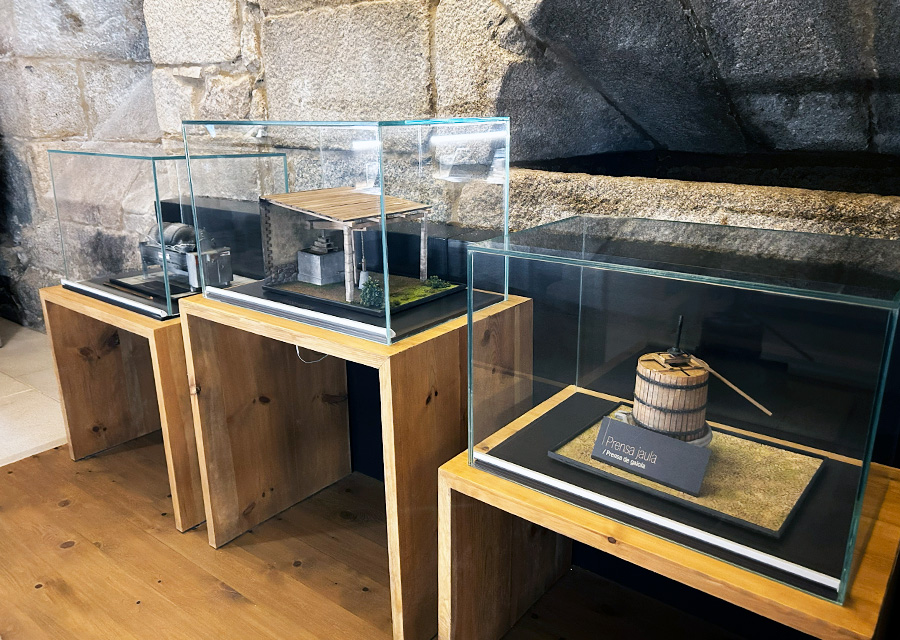
That is why, if we continue walking, we will see three models that illustrate the different types of pressing used in Galicia.
In the center, we have the lagar, the oldest mechanical device used for this purpose in our region, examples of which have been found dating back to Roman times, excavated from large rocky outcrops in the southeast of the province of Ourense. The lagar is a granite vessel, a stone abundant in our area and widely used because it does not impart any flavor or aroma to the must. Once the winepress was filled with the fermentation remains, the screw was turned so that the wooden staves placed on it would exert pressure. The problem with this type of device was that, in addition to occupying a large space (in fact, it was common to have an auxiliary building or a large part of the cellar taken up by the winepress), it also had only one outlet for the must, which meant a very long pressing time, favoring the oxidation of the resulting liquids.
That is why, in the 19th century, the so-called "cage press" or "champagne press" became popular. This press shortened pressing times by allowing the must to flow between the wooden staves, then falling onto a metal platform.
However, both of these types of pressing present a fundamental problem: in order to achieve a higher yield, the winery owner exerted too much pressure on the fermentation remains, thus obtaining very low-quality must that then negatively affected the final product.
Finally, we have the "pneumatic press," the most widely used type of press in industrial wineries today. It consists of a large steel cylinder with a perforated inner wall. An inflated pneumatic chamber presses the grape remains against the walls, then rotates to ensure even pressing. This method yields very high-quality must because the grapes are handled very gently. Furthermore, it can process large volumes of fermentation residue in a very short time-up to 45 tons in 45 minutes.
NATURAL AND MECHANICAL PROCESSES FOR WINE PRODUCTION
Continuing our tour, we will see a large wooden barrel where a video is playing about the chemical and mechanical processes involved in producing wine from our Rías Baixas Designation of Origin.