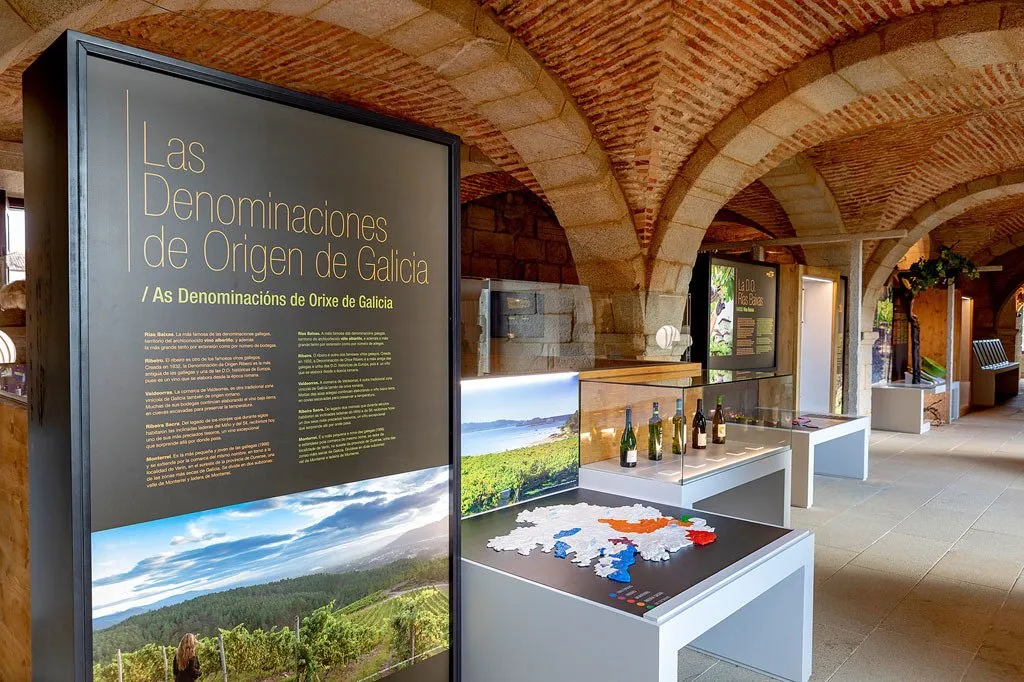
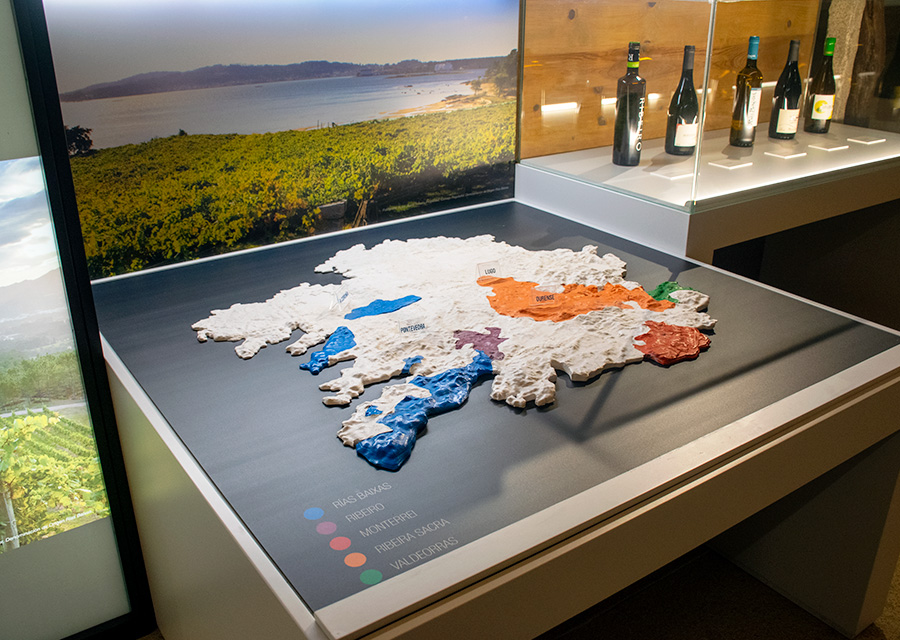
The map of Galicia displays, in different colors, the five Denominations of Origin of Galicia, whose designation represents the highest standard of quality for wines produced in this region.
The Ribeiro Denomination of Origin is the oldest in Galicia and one of the oldest in Europe, established in 1932. The Valdeorras D.O. was established in 1945, followed by the Rías Baixas D.O., which boasts the largest vineyard area and the most wineries. Finally, the Ribeira Sacra and Monterrei D.O.s were added in 1996.
The next display case shows the official labels and back labels of the different Galician D.O.s. These are essential elements to ensure that the contents of the bottle are controlled by the corresponding D.O., and possessing them is a guarantee of quality.
A little further on, we distinguish the five regions encompassed within the Rías Baixas Designation of Origin. The Rías Baixas DO was established in 1980 as the "Albariño Specific Designation," as this is the main white grape variety and the one that would grant the Rías Baixas DO international recognition. From 1988 onwards, it began to be known as the "Rías Baixas DO," a name it retains to this day.
The Rías Baixas DO originated in the Salnés region, which became the area with the highest production of Albariño wine. Later, the Condado do Tea region, where Salvaterra de Miño is located, and the Rosal region were incorporated. In 1996, the Soutomaior region, the smallest in area, was established near Vigo, followed by the Ribeira do Ulla region, very close to the city of Santiago de Compostela.
It should also be noted that one of the requirements for a town to be included in a Designation of Origin is documentary proof of a winemaking tradition in that region. In Salvaterra de Miño, as confirmed by the dates of the documents displayed in the next showcase, such a tradition existed.